Final Reports Published: Health Technology Assessment Policy and Methods Review and Enhanced Consumer Engagement Process

News

Rare Voices Australia (RVA) welcomes the publication of the Health Technology Assessment (HTA) Policy and Methods Review final report (the HTA Review report), Accelerating Access to the Best Medicines for Australians Now and into the Future.

The Hon Ged Kearney MP, Assistant Minister for Health and Aged Care, launched the HTA Review report in Canberra on 10 September. The Assistant Minister acknowledged the extensive consultation and stakeholder input that informed the HTA Review report, emphasising the role of the consumer representatives in the HTA Review Reference Committee (the Committee). The importance of extensive multistakeholder consultation was also reiterated.

As the national peak body for Australians living with a rare disease, overall, RVA is cautiously positive about the HTA Review report which contains 50 recommendations. The Assistant Minister emphasised the Australian Government’s commitment to forming a multistakeholder implementation group to drive implementation of the HTA Review report’s recommendations, which were noted as including both recommendations for sensible and specific changes as well as more visionary reforms.

Positive Aspects for People Living with A Rare Disease*

The HTA Review report must be considered in its entirety with the Committee noting that the recommendations should be considered as a package of reforms. Throughout the final HTA Review report, there is repeated emphasis on:

  • Therapies to address high unmet clinical need (this applies to most rare diseases)
  • Improving time to access life-saving therapies for ultra rare diseases
  • The use and collection of real-world evidence to support HTA decision-making
  • More flexible managed entry and resolution pathways
  • The needs of small patient populations
  • Establishment of a bridging fund for fast access in specific situations
  • Development of an explicit values framework
  • Horizon scanning and proactive pre-HTA processes to identify and introduce health technologies where there is high unmet clinical need
  • Specific measures to make HTA more fit for purpose and timely for highly specialised therapies
  • Commitment to reducing resubmissions and a more streamlined yet flexible HTA system
  • Recognition of the need to measure and continuously improve the impact of these changes to ensure timely, consistent and equitable access

The final HTA Review report and several recommendations also contribute to ensuring a streamlined and proportionate HTA process that is easier for stakeholders to navigate and follow.

We congratulate the Committee for producing a nuanced and considered set of recommendations. Ann Single, RVA Scientific and Medical Advisory Committee member, was a consumer representative on this Committee.

*Please note: This is not an exhaustive list. Download the final HTA Review report to read the recommendations in full.

Enhanced Consumer Engagement Process Recommendations

RVA also welcomes the publication of the recommendations from the Enhanced Consumer Engagement Process, developed by a consumer-led multi-stakeholder Co-design Working Group. Enhance HTA: An Enhanced Consumer Engagement Process in Australian Health Technology Assessment – A Report of Recommendations acts as a companion document to the HTA Review report and includes 10 recommendations to align and elevate the focus on consumer engagement.

RVA was pleased that the publication of these reports as companion documents highlights the importance of consumer input into HTA. We congratulate the Co-design Working Group, which included RVA’s Chief Executive Officer, Nicole Millis, for the strong and clear recommendations in the report.

Implementation of the Recommendations

While RVA is cautiously positive about the HTA Review report, we note some of the recommendations can be further strengthened from a rare disease perspective. RVA has raised this directly with the Minister for Health and Aged Care’s office.

RVA also welcomes the commitment of the government to form an independent, multistakeholder group to oversee implementation. RVA will be advocating for very strong rare disease and consumer expertise on this group.

Rare Voices Australia Partner Forum

RVA will be facilitating our inaugural RVA Partner Forum on 24 September for RVA Partner groups/representatives. The purpose of the session is to:

  • Speak in more detail about the recommendations relevant to Australians living with a rare disease
  • Hear your thoughts on both reports and their recommendations
Details

Date: Tuesday, 24 September 2024
Time: 12pm (AEST)

We will share more information as soon as possible via email and post in the private Facebook group for RVA Partner groups/organisations.

Acknowledgements

RVA thanks the HTA Review Reference Committee (the Committee) and the Enhanced Consumer Engagement Codesign Working Group for their efforts and carefully considered approach to this important work. Additionally, we thank the many stakeholders across the rare disease sector for their strong contributions to both processes.

As the national peak body for Australians living with a rare disease, RVA has ensured the needs of the estimated two million Australians living with a rare disease have been considered throughout these processes. We also acknowledge the rare disease-specific expertise on the Committee and RVA’s consumer representation on the Enhanced Consumer Engagement Codesign Working Group.

This work was informed by, and builds on, The New Frontier – Delivering better health for all Australians. The National Strategic Action Plan for Rare Diseases is also referenced in the final HTA Review report.
Rare Disease Disability Advocacy Update: August 2024

RVA News

As the national peak body for Australians living with a rare disease, Rare Voices Australia (RVA) remains committed to advocating for people living with a rare disease, including those with disabilities. RVA estimates that 100,000 National Disability Insurance Scheme (NDIS) participants live with a rare disease comorbidity. The August Rare Disease Disability Advocacy Update focuses on the government’s response to the Disability Royal Commission (DRC), the NDIS reform agenda, and the evolving concerns within the rare disease community.

Government Response to the Disability Royal Commission

On 31 July 2024, Federal, state, and territory governments released their responses to the DRC’s recommendations.

The DRC made 222 recommendations for state and Federal governments to improve laws, education, employment, and housing options for people with disabilities, noting multiple failings to protect people with disabilities from human rights abuses, and breaching international obligations. Of the 222 recommendations, the Federal Government said 172 fell within its scope. It has accepted 13 recommendations in full and another 117 in principle. The Federal Government has identified another 36 for further consideration.

There has been widespread disappointment in the disability community regarding the government’s failure to fully commit to some of the most crucial recommendations. RVA is concerned about the lack of comprehensive legislative reform and that after nine months of consideration by governments, the systemic issues highlighted by the DRC may not be adequately addressed. Read RVA’s submission to the Disability Royal Commission.

Below is a high-level comparison of RVA’s key recommendations and how they were addressed by the government.

Summary:

Accepted in Full: Recommendations related to the cognitive disability health capability framework and the National Disability Data Asset.

Accepted in Principle: Recommendations related to the National Disability Commission, workforce strategy, and improved access to clinical placements.

Noted: The recommendations regarding the Disability Rights Act, strengthening the Disability Discrimination Act (DDA), and establishing a First Nations Disability Forum were acknowledged but not committed to.

Draft Lists of National Disability Insurance Scheme Supports

RVA has been actively engaged in the NDIS reform agenda in August.

As a member of the NDIS Neurodegenerative, Palliative and Rare Disease Advisory Group, RVA attended an out-of-session consultation on 16 August 2024 with leaders from the National Disability Insurance Agency (NDIA). RVA expressed our concerns regarding the brief consultation periods provided for crucial decisions about eligible supports under the NDIS.

We subsequently provided a detailed submission to the Department of Social Services (DSS) consultation on the draft lists of NDIS Supports and shared our submission with the NDIA. Download RVA’s submission.

Key issues highlighted in our submission include:

  • The use of narrow and prescriptive lists in this complex disability ecosystem is problematic.
  • Lack of time and planning for community/sector engagement and codesign to ensure the ‘transitional’ rules are appropriate.
  • There continues to be a lack of authentic co-design with the disability sector.
  • RVA requests that a Stakeholder and Community Engagement Plan be published.
  • RVA also noted that the draft lists contain significant assumptions that the state and territory governments will agree to fund and provide foundational, mainstream, and community supports for people with disability in a way that meets their needs. Yet, we currently have no assurance they will do so.
  • We are seeking urgent confirmation that where no mainstream service exists or is not practically available, or foundational supports are not yet implemented, the NDIS will continue to fund these reasonable and necessary supports to ensure no person with a disability goes without essential support.
  • RVA remains deeply concerned about sections of the draft NDIS Supports List that refer to ‘Mainstream Health’ responsibilities that will not be considered NDIS Supports, including life-sustaining assistive technology for the management of disability-related health supports.

RVA remains deeply concerned about the implications of these developments for people living with rare diseases and disabilities. The potential for reduced services and stricter eligibility criteria under the NDIS could disproportionately impact our community, many of whom rely on comprehensive and tailored supports to manage their conditions.

RVA appreciates the insights and input from our RVA Partner groups/organisations (rare disease organisations), many of whom also provided detailed submissions for consideration. With the passing of the National Disability Insurance Scheme Amendment (Getting the NDIS Back on Track No.1) Bill 2024 on 22 August, RVA will carefully monitor the finalisation of these lists of NDIS Supports and actively seek to be part of the co-design process for the development of the suite of new NDIS Rules.

Foundational Supports

RVA continues to advocate for formal recognition and engagement as a Disability and Carer Representative Organisation to ensure the considerable and complex needs of people living with rare disease disability impacts are met.

RVA will continue to advocate for a more inclusive, transparent, and rights-focused approach to the NDIS and broader disability reforms. We are working closely with RVA Partner groups/organisations and other advocacy groups to ensure the voices of all people with rare disease disabilities are heard and considered in all policy discussions.

RVA was pleased to receive an in-person invitation to attend the Queensland Disability Conference on 16 August 2024 in Brisbane. We had the opportunity to engage with senior State and Federal Government advisors regarding the challenges of the rare disease community and the arbitrary line that is all too often drawn between disability and health sectors.

RVA will continue to engage with state governments to advocate for comprehensive disability reform through the development of the Foundational Support Strategy. We are actively engaging with government officials, policymakers, and other key stakeholders to emphasise the importance of co-designing reforms with the disability community. RVA will continue to submit formal responses to relevant consultations and work to extend these consultation periods to ensure meaningful input.

RVA encourages all members of the rare disease sector to remain informed about these developments and to actively participate in advocacy efforts. Your voices are crucial in helping to shape policies that affect the rare disease community.

The Navigator Project: Progress Update – August 2024

RVA News

As the lead consortia member on The Navigator Project, which is funded by the Department of Health and Aged Care, Rare Voices Australia (RVA) is excited to share the first progress update since the project commenced in July 2023. RVA would like to acknowledge our consortia partners, the Sydney Children’s Hospitals Network, the Perth Children’s Hospital, and our data sharing partners, Crohn’s Colitis Australia, Mito Foundation and Tuberous Sclerosis Australia for their ongoing dedication to this important work. Background information about The Navigator Project.

Interim Evaluation Findings: January to April 2024

The Navigator Project interim findings reported below are based solely on data from consumer-led organisation-based telehealth services and the RARE Helpline. Ethics approvals for data sharing from the hospital-based Nurse Navigator Programs (NNP) were not in place during the evaluation period (January to April 2024). It is important to note, these findings are based on limited available data, and strong conclusions cannot be made at this early stage of The Navigator Project.

From January to April 2024, a total of 155 people contacted the telehealth services. Almost 60% of service users were individuals living with a rare or complex disease, 40% were family members or carers and the remainder were health professionals. Of those who reported their jurisdiction and rurality status, 71% lived in New South Wales, Victoria or Queensland. Importantly, 44% lived in a rural, regional or remote area. Given only 27% of Australians live outside major cities, this suggests these telehealth services may be reaching a higher proportion of people in regional, rural, and remote Australia. More data is needed to confirm this observation.

The three most common reasons individuals contacted the services were:

  • to get information and/or resources about a disease
  • to request access to health services or health system navigation and,
  • requests for social support

On average, telehealth service staff recorded 3 interventions for each call, and 115.9 minutes responding to each individual request.

Lessons Learned and Updates from Each Service

RARE Helpline
  • Most RARE Helpline service users are diagnosed with a rare disease for which there is no known Australian support group.
  • A significant portion of time spent responding to RARE Helpline service users is related to provision of emotional support and reducing overwhelm and feelings of isolation through listening to people’s stories and validating and normalising their experiences.
  • Additionally, the Helpline works to build users knowledge, confidence and capacity to self-advocate in the different support systems they need to navigate.
  • Data from the RARE Helpline service has highlighted key gaps, including gaps for specific disease areas that RVA advocacy staff were able to feed back to the relevant community organisation.
  • Gaps and needs highlighted by the RARE Helpline are actively informing development of the Rare Awareness Rare Education (RARE) Portal.

Consumer-led Organisation Based Telehealth Services

Symptom management support and advice on access to health services or health system navigation were the most common reasons for contact among the consumer-led organisations. Compared with interventions provided to RARE Helpline service users, more users of these disease-specific telehealth services were provided with symptom management and treatment-related information. Consumer-led organisations  have reported that being part of The Navigator Project has added value to their services. All consumer-led organisations have incorporated a user experience survey based on the survey developed for the RARE Helpline and agreed to collect additional data/refine data from their services to support evaluation of The Navigator Project. This includes additional demographic data, which will be used to support improvements that better meet the needs of their communities.

Hospital-based Nurse Navigator Programs

Since June 2023, the NNPs have been developing their service models and in April 2024 they soft launched their services. Ethics was approved in July 2024 and data sharing with RVA for evaluation of The Navigator Project has commenced. Data from the NNPs will be included in the next progress update towards the end of 2024.

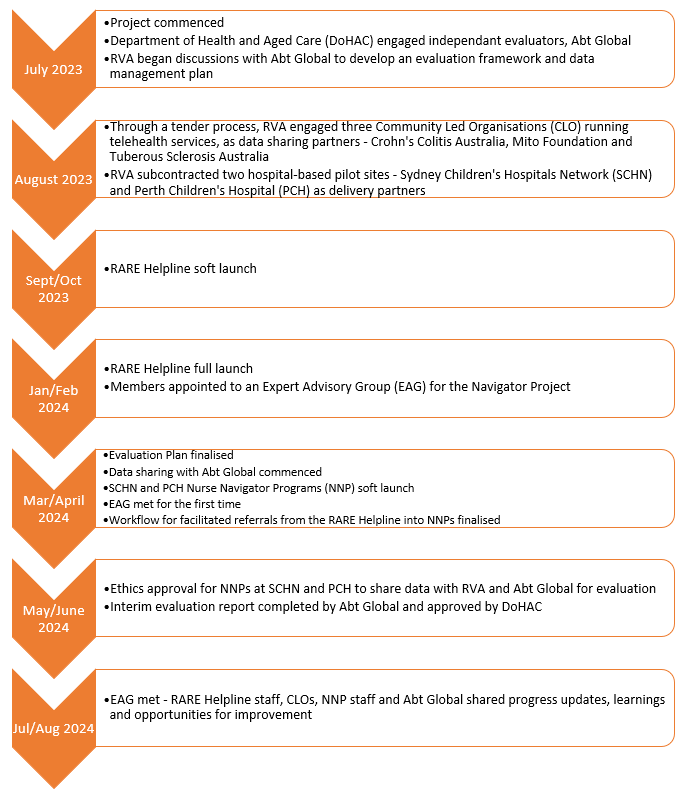
Key Milestones to Date

Key milestones to date - The Navigator Project

Background: The Navigator Project

The objectives of The Navigator Project are to: 

  • Support people living with rare and complex diseases, their families and carers.
  • Support people to improve their health literacy and engage with the health system.
  • Link people with existing health services and/or professionals to access specialised or targeted support to manage complex care needs.
  • Target telehealth nurse-led support for people with rare and complex conditions, where there is limited information on their condition or access to services, where they are in situations of acute need, or where they are unable to self-manage their condition.
  • Increase the potential for system improvement as the data collection and evaluation components of The Navigator Project will generate evidence to guide future government investment for service navigation.

The Navigator Project involves implementing two models of patient navigation support and collecting data from a third model of telehealth services delivered through three consumer-led rare and complex disease organisations.

Telehealth Services

1. The RARE Helpline is a national, non-disease specific telehealth service that aims to provide timely access to information and answer key questions from people living with a rare and/or complex disease. The RARE Helpline is staffed by RVA personnel, including those with qualifications/training in psychology, social work and Mental Health First Aid.

2.Telehealth Nurse Service Navigation Trial Sites: Two discrete non-disease specific services, attached to the clinical genetic services of the Sydney Children’s Hospitals Network (the Rare Kids Navigator Project) and Perth Children’s Hospital (Rare Care Centre Navigator Project). The telehealth nurses provide intensive care coordination and, in some instances, case management.

3. Three consumer-led rare and complex disease organisations providing telehealth nurse services:

  • Crohn’s and Colitis Australia
  • Mito Foundation
  • Tuberous Sclerosis Australia

Data from each of these models will facilitate an evaluation of the impact and benefit to individuals, families, carers, the health system, and the overall cost-effectiveness and sustainability of each model.

Revised Australian Framework for National Clinical Quality Registries (2024) Released

News

The Australian Commission on Safety and Quality in Health Care (the Commission) has released the revised Australian Framework for National Clinical Quality Registries (2024). Read more background information and download the revised Australian Framework for National Clinical Quality Registries (2024) on the Commission’s website.

Australia’s national Clinical Quality Registries collect, analyse and report information about the care and outcomes being delivered by health service organisations. They serve as a key driver of ongoing improvements in the safety and quality of the care provided to Australian consumers, including Australians living with a rare disease.

As the national peak body for Australians living with a rare disease, Rare Voices Australia (RVA) lodged a Submission and participated in the consultation process for the Framework for Australian clinical quality registries Second Edition – consultation version. RVA is in the process of making our way through the revised Australian Framework for National Clinical Quality Registries (2024) and will provide an update to highlight key points of relevance to Australians living with a rare disease shortly.

Rare Voices Australia Recap: Human Genetics Society of Australasia’s 47th Annual Scientific Meeting

RVA News

Rare Voices Australia’s (RVA) Education and Advocacy Manager, Louise Healy, and Research and Evaluation Manager, Dr Falak Helwani, were delighted to attend the Human Genetics Society of Australasia’s (HGSA) 47th Annual Scientific Meeting between 10 and 13 August 2024. The theme of the meeting was, Beyond Next Generation: The Future of Genomics. At the meeting, attendees heard from a variety of Australian and international experts speaking on topics ranging from emerging gene therapies and pharmacogenomics, to integrating genomics into medicine and novel approaches to genetic counselling. We also heard updates from several RVA research partners, including members of the GenSCAN Consortium.  

This year, HGSA donated booth space in the exhibitor hall to not-for-profit organisations, including RVA and RVA Partner Genetic Alliance Australia. RVA would like to thank the organisers for the opportunity to have a dedicated space to showcase RVA’s work and for encouraging delegates to visit and learn more about our work. Louise Healy was pleased to present RVA’s poster, Resources for People from Priority Populations Living with a Rare Disease: Lessons Learned and Gaps Identified, co-authored by Louise, Jess Brooklyn (RVA’s Education Project Officer) and Nicole Millis (RVA’s Chief Executive Officer). Louise also co-chaired one of the oral poster sessions.

RVA would like to congratulate our Scientific and Medical Advisory Committee (SMAC) members A/Prof Paul Lacaze and Dr Jane Tiller for their thought-provoking workshop on population genomic screening of adults for medically actionable conditions. Congratulations also to SMAC member, Dr (Elizabeth) Emma Palmer, for her presentation in the Australasian Association of Clinical Geneticists special interest group session, which brought attention to outcomes from the Rare Disease Awareness, Education, Support and Training (RArEST) Project, including the National Recommendations for Rare Disease Health Care, as well as the RARE Helpline and the Rare Awareness Rare Education (RARE) Portal.

Australia and the World Health Assembly Resolution on Rare Diseases

News

Rare Diseases International (RDI) is working with its members, including Rare Voices Australia (RVA), to call for a World Health Assembly (WHA) Resolution on Rare Diseases to request the development of a Global Action Plan on Rare Diseases. The Global Action Plan on Rare Diseases will assist in ensuring Universal Health Coverage means ‘health for all’ rather than ‘health for most,’ so that no one is left behind. The Arab Republic of Egypt, the State of Qatar and Spain are co-sponsoring the WHA Resolution.

As the national peak body for Australians living with a rare disease, RVA has been liaising with RDI and the Australian Government to encourage Australia to support the WHA Resolution. There has been much interest from the Department of Health and Aged Care and discussions continue.  

Alignment with the National Strategic Action Plan for Rare Diseases

‘State, national and international partnerships’ are one of the critical enablers of the Australian Government’s National Strategic Action Plan for Rare Diseases (the Action Plan). ‘State, national and international partnerships as well as cross-sector collaboration’ is also Theme #7 in the Achieving Progress section of the Action Plan.

Interested in Learning More About the World Health Assembly Resolution on Rare Diseases?

RDI, the Arab Republic of Egypt, the State of Qatar and Spain are co-hosting the Towards a WHA Resolution on Rare Diseases 2025 webinar on 30 August. Learn more about the webinar and register to join the session via RDI’s website.

New Mental Health and Rare Disease Resources for Western Australian Consumers and Health Professionals

RVA News

Rare Voices Australia, with support from Western Australia’s (WA) Office of Population Health Genomics (OPHG), has progressed aspects of the Australian Government’s National Strategic Action Plan for Rare Diseases with a focus on mental health and wellbeing. Two Mental Health and Rare Disease fact sheets, customised for WA, are available to download. Please feel free to share these resources widely with your networks to help spread the word.

Download the Fact Sheets

Mental Health and Rare Disease fact sheet for consumers [PDF]

Mental Health and Rare Disease fact sheet for health professionals [PDF]

How the Fact Sheets Were Developed

The fact sheets were developed based on a rare disease and mental health and wellbeing landscape analysis combined with consultations with a wide range of stakeholders, including people living with a rare disease; rare disease groups/organisations; clinicians with rare disease expertise; mental health professionals; and WA based community organisations.

Public Hearing: Joint Standing Committee on the National Disability Insurance Scheme – Participant Experience in Rural, Regional and Remote Australia

RVA News

On 28 June 2024, Rare Voices Australia (RVA) was invited to a public hearing to present to the Joint Standing Committee on the National Disability Insurance Scheme (the Committee) regarding their Inquiry into the participant experience of people living in rural, regional and remote areas. This invitation was based on the strength of RVA’s submission to the Committee in February 2024. We thank the RVA Partner groups/organisations that contributed examples of their lived experience for the submission. Read the submission.

Fiona Lawton, RVA’s Disability Advocacy Manager, and Louise Healy, our Education and Advocacy Manager, represented RVA as the national peak body for Australians living with a rare disease. RVA remains concerned that some of the questions and comments from policymakers at the public hearing indicate an ongoing lack of understanding about the important link between rare diseases and disability, and most importantly, how this impacts a significant number of Australians living with a rare disease. (RVA estimates that 100,000 NDIS participants live with a rare disease comorbidity.) Certain questions displayed a very limited understanding of the arbitrary line policymakers often draw between health and disability supports, creating significant gaps in care and support for those with a disability caused by a rare disease. RVA attempted to raise these concerns during the public hearing. We have also responded to questions on notice regarding these matters, expressing our concerns and highlighting common experiences raised during our virtual roundtable engagement session in April 2024 with RVA Partner groups/organisations.

Public Hearing Hansard Transcript

You can read the questions and comments raised in the public hearing Hansard transcript. RVA believes our responses to the questions on notice will be published on the Inquiry web page.

Rare Voices Australia’s Ongoing Rare Disease Disability Advocacy

RVA will continue having robust discussions with the National Disability Insurance Agency, the Hon Bill Shorten MP, the Minister for the National Disability Insurance Scheme, and other policymakers to advocate for rare disease data collection and rare disease expertise to inform current reform activities and policy codesign.


Newborn Bloodspot Screening Update: July 2024

News

Newborn bloodspot screening (NBS) is an important program that supports the earliest possible diagnosis of some rare diseases. Rare Voices Australia (RVA), alongside other rare disease stakeholders, including RVA Partner groups/organisations, have called for increased equity, timeliness and consistency of screening for several years. While there is more work to do, the Commonwealth’s investment and State Governments’ commitment to a nationally consistent NBS Program has resulted in important progress being made (scroll down to the bottom of the article for more background information).

Newborn Bloodspot Screening Updates: July 2024

  • Five conditions were identified and considered for technical advice: Niemann-Pick disease, Batten disease (CLN2), Fabry disease, Krabbe disease and MPS III (Sanfilippo syndrome)
  • Based on the technical advice provided by the NBS Program Management Committee (PMC), state Health Ministers have decided that the five conditions listed above will not be referred to the Medical Services Advisory Committee (MSAC) for health technology assessment   

As the national peak body for Australians living with a rare disease, RVA has engaged with the Australian Government to reiterate the importance of transparent and publicly available information regarding how technical advice is developed and the basis for the recommendations provided. This information equips rare disease groups/organisations with important information so that they are informed and can consider the best next steps, including evidence gathering or alternative pathways for earliest possible diagnosis.

RVA has also repeatedly raised the importance of consumer input into the development of technical advice given this is a critical part of the NBS decision making pathway outlined by the Commonwealth. Additionally, RVA has been engaging with the RVA Partner groups/organisations (rare disease groups/organisations) impacted by the recent technical advice given regarding next steps and will continue doing so. RVA provides customised mentorship and education to our RVA Partner groups/organisations. Learn more on our Become an RVA Partner web page.

Additional Background Information: Newborn Bloodspot Screening

Australian babies have been screened using NBS since the 1960s and while there is more work to do, several promising developments have been progressed in recent times, including the Australian Government’s investment of $25 million in the 2024-25 Federal Budget to support the continued delivery of NBS expansion and consistency of conditions. Additionally, for the first time in 60 years, Australia has an agreed national list of NBS conditions and there is specific funding to achieve consistency across the country, cementing Australia as a world leader in NBS. Learn more about Australia’s NBS program on the Department of Health and Aged Care’s website.

Launched: Department of Health and Aged Care’s Australian Health and Medical Research Workforce Survey

News

In May 2024, the Hon Mark Butler MP, Minister for Health and Aged Care, announced the Australian Government’s commitment to developing a National Health and Medical Research Strategy (the Strategy). Read the media release. The aim of the Strategy is to help target funding and strengthen Australia’s world-leading health and medical research capabilities into the future to further improve the health and lives of Australians.

Recently, the Department of Health and Aged Care launched an Australian Health and Medical Research Workforce Survey (the Survey), which is part of extensive consultations that will contribute supporting evidence to the development of the Strategy and future policies.  The aim of the Survey is to understand the demographic features, work environment, challenges, and motivations of health and medical researchers across Australia, including those in research support roles.

One of the three foundation principles in the Australian Government’s National Strategic Action Plan for Rare Diseases (the Action Plan) highlights the need for sustainable systems and workforce, which will also assist with implementation across all three key Action Plan Pillars (Awareness and Education; Care and Support; and Research and Data). More specifically, the following Priorities in the Action Plan emphasise the importance of embedding research into clinical care for people living with a rare disease.

Priority 1.3: ‘Develop a national rare disease workforce strategy that responds to current and future demands, including the impact of genomics’

Priority 3.4: ‘Translate research and innovation into clinical care; clinical care informs research and innovation’

Why is this important for Australians living with a rare disease?

The importance of the health and medical research workforce for people living with a rare disease and their families cannot be overstated. This workforce is vital to advancing understanding of the mechanisms of rare diseases, identifying and implementing new and novel health technologies, and developing best practice care and support.

Driven by the inherent lack of knowledge, treatments, and evidence-based care and support in rare disease, the overwhelming majority of rare disease stakeholders, including people living with a rare disease and rare disease representatives, have experience advocating for, and participating in, research.

Rare Voices Australia encourages individual rare disease stakeholders who have had either direct or supportive roles in research, including those in the not-for-profit space, to take part in this Survey. The Survey is open until 9 August 2024 and should take no longer than 10 to 15 minutes to complete.

Participate in the Survey

Access the Survey.