Rare disease organisations are an important part of the Australian rare disease community. These organisations can understand, capture and communicate the lived experience of those impacted by a rare condition in a way no one else in the sector can. The rare disease community has specific and essential expertise in living with a rare condition and understanding the challenges, needs and burdens these conditions impose. This makes rare disease organisations and their leaders an essential part of the sector.
“Rare disease organisations play a key role in raising disease awareness and providing critical person-centred information. These organisations are vital to the rare disease sector and often fill gaps in thesystem, not just in terms of awareness and education, but also care and support and, increasingly,in the research sphere.” — National Strategic Action Plan for Rare Diseases (2020)
The National Strategic Action Plan for Rare Diseases (the Action Plan) recognises the critical role rare disease organisations play in the rare disease sector. Providing support, education, advocacy and initiating research in the rare disease sector is complex.
To help address the need for additional support and resources to strengthen the rare disease sector, which is acknowledged in the Action Plan, Rare Voices Australia (RVA) is launching (the Guide).
Who Is the Guide for and How Can It Be Used?
The Guide is for both established rare disease organisations and those who are interested in setting up an organisation. For existing rare disease organisations, the Guide can be used in several ways to complement the current status, resources and development phase of your organisation. For those who are investigating how to establish an organisation, this is an easy to follow resource that covers the key areas to consider.
Chapter Breakdown
Chapter 1: Introduction to Rare Diseases, RVA, the Australian Landscape and the Action Plan Chapter 2: Rare Disease Organisation Strategy Chapter 3: The Vital Roles of Rare Disease Organisations Chapter 4: Ethical Rare Disease Organisations Chapter 5: Governance Foundations Chapter 6: Funding Your Rare Disease Organisation Chapter 7: Community Engagement Appendices: Assessment Tools and Planning Template
Each section also contains information about the topic, links to relevant resources and a checklist or self-evaluation tool for identifying current strengths and areas for development.
Thank you to several of our RVA Partner organisations who contributed to the Guide throughout its evolution.
If you have any questions about this Guide or any other education-related matters, please reach out to RVA’s Education and Advocacy Manager: [email protected]
Rare Voices Australia (RVA) is looking to hire a Project Officer – Mental Health and Wellbeing (Maternity Leave Position).
The Project Officer – Mental Health and Wellbeing will play a key role in delivering the RArEST (Rare Awareness, Education, Support and Training) Project. The RArEST Project will contribute to the collaborative implementation of the National Strategic Action Plan for Rare Diseases. The successful candidate will work alongside the RVA team to identify the unmet needs of Australians living with a rare disease.
The Project Officer – Mental Health and Wellbeing will help to research, design and deliver customised and evidence-based mental health and wellbeing resources to a range of stakeholders in the rare disease community.
This position is suited to an individual with exceptional communication and people skills. Strong skills and experience in workshop facilitation and public speaking are required.
Today’s Victorian 2022-23 Budget included funding to expand the state’s newborn screening program.
In recognition of Rare Voices Australia’s (RVA) leading role in national newborn bloodspot screening advocacy, Martin Foley MP’s (Minister for Health) office reached out to provide RVA with more detail regarding this announcement.
RVA has been advised that in total, $4.1 million over 4 years will be provided to add spinal muscular atrophy (SMA), severe combined immunodeficiency (SCID) and congenital adrenal hyperplasia (CAH) to Victoria’s newborn screening program. A lead-in time of up to 12 months will allow for the establishment of the required staffing and equipment, in accordance with the national recommendation endorsed by Australian Governments, to ensure the successful rollout of quality and safe screening. RVA anticipates that more information will be made available in the near future and will provide updates accordingly.
In 2022, Rare Voices Australia (RVA) is celebrating 10 years of rare disease advocacy. RVA’s 10th Anniversary Ambassador Program (the Ambassador Program) is one of several initiatives we are unveiling in 2022 to celebrate 10 years of rare disease advocacy. The overarching theme of the Ambassador Program is, Illuminating People Living with a Rare Disease.
We are thrilled to welcome our first group of official 2022 RVA Ambassadors and thank them for being involved in this new initiative. Each ambassador brings their own unique lived experience of rare disease. We will be sharing more about our RVA Ambassadors over the course of 2022 so be sure to follow RVA’s social media channels and sign up to receive our monthly eNewsletter.
RVA is currently seeking expressions of interest from Aboriginal and Torres Strait Islander people and people from culturally and linguistically diverse (CALD) backgrounds who are interested in becoming a 2022 RVA Ambassador (see the ambassador requirements). Those interested are encouraged to reach out to RVA: [email protected]
Introducing our 2022 RVA Ambassadors
Katie Alexander
Image credit: Alison Wynd, 2019, News Corporation
Frequent falls, extreme fatigue and pain led to Katie’s diagnosis of Dermatomyositis. The rare disease destroys skin, muscles, tendons and organs reducing strength, dexterity and mobility. It can present with cancer, cardiac and auto-immune conditions. Myositis is fatal when inflammation scars the heart (Cardiomyopathy) and lungs (Interstitial Lung Disease). Katie’s Myositis symptoms were untreated for nearly 40 years until advanced disease prevented her from climbing stairs and rising from chairs. By then her muscles were wasting, dying and shortening. Katie had problems chewing, swallowing and speaking. Significant hair loss, skin rashes, peeling, lumps and blood spots changed her appearance. The aggressive disease was resistant to pharmacological treatment (steroids, chemotherapy, immunotherapy) until a kinase (JAK) inhibitor was trialled in 2021. Katie is very grateful for this respite and now shares her experiences of rare disease, disability and family violence through advocacy roles with the National Disability Insurance Agency (NDIA), Safe Steps, Peter MacCallum Cancer Hospital, Monash University and RMIT University.
Andrew Bannister
Andrew was born with three rare brain malformations – Periventricular Nodular Heterotopia (PVNH), Polymicrogyria and Cerebella Hypoplasia – as well as two other congenital malformations. His cerebellum is a quarter of the average size. These rare malformations have not stopped him achieving many things even though he has an intellectual and physical disability. Andrew’s determination to overcome the obstacles in his life inspires people, yet it is he who wants to help others by raising awareness about rare diseases. Among others, Andrew played a key role in the formation of the first Parliamentary Friends of People with Rare and Undiagnosed Diseases in Western Australia in 2021. Additionally, since 2020, Andrew has played a pivotal role in organising illuminations for Rare Disease Day in Australia.
Lachy Beckett
Lachy was diagnosed with a rare disease called Juvenile Dermatomyositis (JDM) when he was three years old. JDM is a form of Myositis affecting children. Myositis is a group of rare autoimmune diseases affecting the muscles. Lachy has been active as a volunteer in raising awareness for people with rare diseases for the past 10 years. He is currently involved in a business start-up with his family and in his spare time, loves playing guitar, reading and playing chess.
Ebony Callaghan
Ebony is 24 years old, lives with Intestinal Failure and requires Home Parenteral Nutrition. For the first few years of her life, no one noticed anything unusual apart from severe reflux and moderate constipation. At 11 she became unwell with what was thought to be a simple gastro bug, but after a week or two, she wasn’t better and was admitted to hospital for investigation. At 17 she was eventually diagnosed with Superior Mesenteric Artery Syndrome (SMAS), a very rare and life-threatening digestive system disorder that occurs when the duodenum (the first part of the small intestine) is compressed between two arteries (the aorta and superior mesenteric artery). Ebony feels incredibly lucky to have been chosen to be an RVA Ambassador and looks forward to sharing more of her story and lived experience.
Nathan Charles
At three months of age, Nathan was diagnosed with Cystic Fibrosis (CF) and his parents were told he may not make it to his 10th birthday. Nathan’s resolve never faltered despite a future that was likely to be filled with challenges. His passion for rugby eventually saw him living out his childhood dream of playing for Australia in the Wallabies’ second test against France at the age of 25. Throughout his career and life, Nathan has been adamant not to be defined by CF and has never viewed his condition as an obstacle to success in any facet of life. Today, Nathan is the Chief Executive Officer of Rugby WA.
Tim Fulton
Tim was formally diagnosed with Adult-onset Still’s disease (Still’s disease) in 2016 at the age of 22. Still’s disease is a rare systemic, auto-inflammatory condition that affects between one in 100,000 to one in 1,000,000 people globally. In August 2020, to stay on top of his mental health, combat the effects of calcium leaching from medication and driven by his desire to encourage people, in particular the rare disease community, Tim set himself the goal of running 100km before Rare Disease Day — a big audacious goal given his health! He began the Instagram page Running Rare to document his progress and this has evolved to the development of an accompanying website to encourage and uplift the rare disease community. Tim is a big believer of living with a ‘it is possible’ attitude. This doesn’t mean you’re naive to the reality of your circumstances, but it does encourage and motivate you to think about what might make something possible — and that is such an important first step.
Tammie Rees
Tammie is the mother of two children and lives in regional Victoria. Her youngest is 5 years old next and was born and diagnosed in 2017 with Maple Syrup Urine Disease. Tammie says it’s been a very big learning journey but one in which her family has managed to find their feet and now are ready to have their voices heard on important issues such as inclusion, research, cures and anything else they can do to help. She is excited to see what we can achieve together. When Tammie is not busy working and with family life, she enjoys running.
Beck Webber
In 2014, Beck noticed small micro changes in the way her body operated, which was noted in her medical files. On Christmas night in 2017, she fell down a flight of 11 stairs after losing her feet on the top step. This resulted in her spending the next 12 months with a crushed disc and surgery to replace the disc and rods in her back. In 2020, Beck noticed she was becoming highly fatigued, sleeping all day and her legs either felt like jelly or stiff as a board. After a blood test was sent to the United States of America for genetic testing, she was eventually diagnosed with Spinocerebellar ataxia type 36 (SCA36). Beck is looking forward to ‘illuminating’ the rare disease cohort in a more public manner and sharing her experiences as a para equestrian athlete.
Renae Wood
Renae is 27 and is based in Brisbane, Queensland. She was born with a rare disease called Epidermolysis Bullosa (EB), which is a condition that causes fragile, blistering skin that also tears easily and scars. The gene fault that caused Renae’s EB is rare and is also responsible for her diagnoses of alopecia and dilated cardiomyopathy. Living with rare disease can feel isolating and can make life unpredictable, which is why Renae feels it’s important for those living with a rare disease to share their experiences. Renae’s hope is to empower people to share their stories, so that we are reminded that we’re not alone but are part of one brave community!
Rare Voices Australia (RVA) attended the launch of a world-first clinical trial for people living with Ataxia-Telangiectasia (A-T) at Wesley Medical Research in Brisbane with the Hon. Greg Hunt MP, Minister for Health and Aged Care; the clinical trial team led by Dr David Coman and Prof Martin Lavin; RVA Partner BrAshA-T; and children living with A-T and their families.
As there are currently no effective treatments to treat A-T, this trial is an important milestone for the A-T community. As highlighted in the National Strategic Action Plan for Rare Diseases, participation in a clinical trial is often the only way to access treatment for many people living with a rare disease.
What is A-T?
A-T is a rare genetic metabolic disorder with an incidence of 3 in 1 million births. A-T is a life-threatening disorder that causes cerebral palsy, muscular dystrophy, and immune deficiency leading to a cystic fibrosis-like lung disease and cancer. A-T progresses rapidly, robbing children of their ability to walk, speak and swallow—their minds remain unaffected. There are currently no effective therapies to treat A-T.
For more information about A-T, support or to learn more about this clinical trial, please visit BrAshA-T’s website.
On Tuesday, 29 March 2022, the Hon Josh Frydenberg MP (Treasurer of Australia) announced the Morrison Government’s 2022-23 Federal Budget, which included a record investment in Australia’s health system with a total commitment of $537 billion over the next four years.
As the national peak body for Australians living with a rare disease, Rare Voices Australia (RVA) attended the Department of Health’s Portfolio Briefing webinar presentation and Q&A with the Hon Greg Hunt MP (Minister for Health and Aged Care); the Hon Dr David Gillespie MP (Minister for Regional Health); the Hon David Coleman MP (Assistant Minister to the Prime Minister for Mental Health and Suicide Prevention); and Senator the Hon Richard Colbeck (Minister for Senior Australians and Aged Care Services). The session was facilitated by Dr Brendan Murphy, Secretary of the Department of Health.
In our Budget Statement, RVA has highlighted areas of the Budget we believe are most relevant to Australians living with a rare disease and the rare disease sector.
On Tuesday, 29 March 2022, the Hon Josh Frydenberg MP (Treasurer of Australia) announced the Morrison Government’s 2022-23 Federal Budget, which included a record investment in Australia’s health system with a total commitment of $537 billion over the next four years.
As the national peak body for Australians living with a rare disease, Rare Voices Australia (RVA) attended the Department of Health’s Portfolio Briefing webinar presentation and Q&A with the Hon Greg Hunt MP (Minister for Health and Aged Care); the Hon Dr David Gillespie MP (Minister for Regional Health); the Hon David Coleman MP (Assistant Minister to the Prime Minister for Mental Health and Suicide Prevention); and Senator the Hon Richard Colbeck (Minister for Senior Australians and Aged Care Services). The session was facilitated by Dr Brendan Murphy, Secretary of the Department of Health.
RVA is currently reviewing the Budget in detail and what it may mean for Australians living with a rare disease. We will release a full statement shortly.
At an initial glance, key areas of the Federal Budget 2022-23 most relevant to the rare disease sector include:
Ensuring telehealth remains a permanent part of Australia’s health system
$4.6 billion over four years to drive improvements in health outcomes for Aboriginal and Torres Strait Islander people
$81.2 million to provide carrier screening for three rare genetic conditions (cystic fibrosis, spinal muscular atrophy (SMA) and fragile X syndrome), making Mackenzie’s Mission a permanent part of Australia’s health system
$2.6 billion for the Medical Research Future Fund (MRFF) and $3.7 billion for the National Health and Medical Research Council (NHMRC)
$28.1 million to commence work to establish Genomics Australia to support the implementation of genomics as a standard of healthcare in Australia
New listings on the Pharmaceutical Benefits Scheme (PBS) for the treatment of cystic fibrosis and SMA in children less than nine-months old with type 1 SMA or pre-symptomatic patients with 1-2 copies of the SMN2 gene
$648.6 million for Stage 2 of the Government’s Mental Health and Suicide Prevention Reform Plan
In 2022, Rare Voices Australia (RVA) is celebrating 10 years of rare disease advocacy. Thank you to everyone who contributed to RVA’s work over the last decade. From former RVA Board Directors and Scientific and Medical Advisory Committee members to RVA Partners, former staff and all stakeholders, we acknowledge your ongoing support. While much work still needs to be done to achieve the best possible outcomes for Australians living with a rare disease, we are incredibly proud of RVA’s work and achievements to date.
10th Anniversary Ambassador Program
RVA will be unveiling several initiatives throughout the year to celebrate this milestone, including RVA’s 10th Anniversary Ambassador Program (the Ambassador Program). The overarching theme of the Ambassador Program is: Illuminating People Living with a Rare Disease. The Ambassador Program will provide people living with a rare disease (which includes carers and families) and those with professional experience of rare diseases, with the opportunity to become an official RVA Ambassador.
We are currently seeking expressions of interest (EOIs) from those interested. We are looking for 10 ambassadors for our 2022 Ambassador Program. Before applying, please read the below information to see if you are a suitable candidate.
Ambassador requirements
Lived or professional experience of rare diseases
Demonstrated use of personal network and platforms to advocate for the best outcomes for the broader rare disease community
A demonstrated supporter of RVA
Willing to review and consider signing RVA’s Ambassador Agreement, which can be provided on request to those interested
Aligned with RVA’s ‘ways of working’ as an RVA Ambassador, which are outlined below
We are person-centred
We want the outcomes that are best for each person as an individual. We will be driven by the needs of each person and by what works best for them. We won’t impose our assumptions on people.
We will actively build and maintain partnerships
We are the voice of the sector, magnifying the voices of all stakeholders that share our goals. We recognise that achieving the transformation we want to see in Australia will require us working in partnership with stakeholders.
We aim for a unified voice
We recognise that without a unified voice, the rare disease sector cannot be successful in achieving the support for people living with a rare disease that we need. As a result, we will prioritise consultation and conversation within the sector to ensure that our voice to policymakers and the broader community is as unified as possible.
We work for equity of access and participation
We believe that equity of access and participation is vital for all people living with a rare disease in Australia. In our initiatives, we will ensure that equity is a key factor in our planning and design. And in our advocacy, the principles of equity will be foremost in our messaging.
We will equip and empower
We aim to equip and empower organisations and people to help them advocate and work for themselves.
We are solutions and results oriented
We want to see results for people living with a rare disease in Australia. We are not going to be bound to theoretical models. We will adopt what works and will test our initiatives against the results they deliver.
We are credible
We recognise that our effectiveness is only as good as our credibility and trustworthiness. We will ensure that all of our actions and words build our credibility, rather than erode it. We recognise that trust takes a long time to build but can be quickly lost.
We will adopt a systemic focus
We are uniquely positioned to engage in systemic advocacy. Effective reform to systems and processes must be prioritised to reduce individuals and groups repeatedly facing common challenges. This is vital to achieving sustainable change at scale.
Ambassador opportunities
RVA Ambassadors will have the opportunity to:
Share their personal story, which will be featured as a written article on RVA’s website. We will also invite ambassadors to film a short video to complement their written story. Each personal story will also be promoted in an edition of our monthly eNewsletter and RVA’s social media channels.
Send a copy of the National Strategic Action Plan for Rare Diseases (the Action Plan),to their local Federal and State Members of Parliament (MPs) as an official RVA Ambassador. Ambassadors are invited to organise a meeting with their local MPs to speak about their personal experience of living with a rare disease and rare diseases in general.
Attend RVA events in 2022 in a volunteer capacity, where appropriate.
Use their networks (e.g. social media, newsletter databases etc.) to cross promote RVA’s work.
Contribute to relevant media stories from the perspective of an individual living with a rare disease or as a professional who has worked with rare diseases.
All RVA Ambassadors will receive a Welcome Pack. RVA will also support each ambassador in their role as needed.
10th Anniversary Ambassador Program Welcome Pack
A brief introduction to RVA and how we work, alongside training as required
This Rare Disease Day (28 February 2022), Rare Voices Australia (RVA) launched the much-anticipated Rare Metabolic Disease Workforce White Paper: Towards a Strengthened Rare Disease Workforce for Australia (White Paper).
RVA hosted a webinar to launch the White Paper for those involved in the consultation process. Thank you to the following people who spoke at the webinar:
Dr Angela Jackson: White Paper author and economist;
Dr Kaustuv Bhattacharya: President, Australasian Society for Inborn Errors of Metabolism (ASIEM); and metabolic paediatrician, Genetic Metabolic Disorders Service (NSW);
Anita Inwood: Director, Queensland Lifespan Metabolic Service; and
Dr Falak Helwani: Co-author of the White Paper; and Research and Evaluation Officer, RVA.
Special thanks to the Project Steering Committee, RVA Partners, people living with a rare metabolic condition, the specialist metabolic workforce, industry and everyone else who contributed to this critical study.
Communicate these findings to all key stakeholders;
Further develop draft strategic actions in response to the key findings;
Engage and collaborate with Commonwealth, state and territory governments, hospital administrators and ASIEM to review draft strategic actions and develop effective and sustainable solutions; and
Finalise strategic actions to progress much needed change in each jurisdiction that is aligned with international best practice.
White Paper background information
Australia’s first nationally coordinated effort to address rare diseases—the National Strategic Action Plan for Rare Diseases —called for the development of a national rare disease workforce strategy that responds to current and future demands, including the impact of genomics. ‘Sustainable systems and workforce’ is one of three foundation principles of the Action Plan. This White Paper is a pilot project focusing on the workforce challenges of the rare metabolic condition workforce and is an initial step to progress the development of a national rare disease workforce strategy. Many of the pilot’s findings will be transferable to other groups of rare diseases and will inform the development of a rare disease workforce strategy more broadly.
RVA, the national peak body for Australians living with a rare disease, engaged Equity Economics and Development Partners to undertake this comprehensive review and analysis of the Australian rare metabolic workforce.
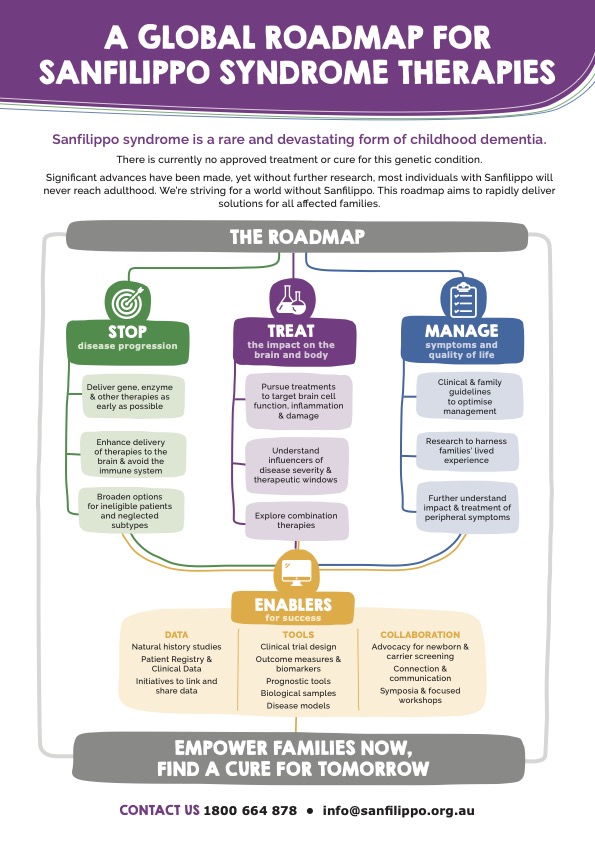
Rare Voices Australia (RVA) congratulates RVA Partner, Sanfilippo Children’s Foundation Australia, for their leading role in the development and delivery of a Global Roadmap for Sanfilippo Syndrome Therapies (Roadmap). This Roadmap was a joint effort with Cure Sanfilippo Foundation (USA) and other international sister foundations. It was developed collaboratively through the expertise of clinicians, researchers, industry leaders, family-led organisations and families from around the globe.
The Roadmap aims to drive research towards effective therapies and better outcomes for families affected by Sanfilippo syndrome.
The Roadmap on a Page
The pillars of the Roadmap focus on how to STOP Sanfilippo at its root cause, how to TREAT the underlying impact of the disease on the brain and body, and how to better MANAGE symptoms and improve quality of life. The research themes are underpinned by a set of ENABLING INITIATIVES – data, research tools and collaborative platforms – that could support multiple aspects of research along the entire therapy development pipeline.
With the Roadmap in hand, Sanfilippo support organisations from around the world will be coming together to focus attention on their shared priorities.
Critical enabler: State, national and international partnerships.
All four priorities under Pillar 3: Research and Data, of the Action Plan, and in particular Action 3.2.3: Support collaborative research into rare diseases in Australia and internationally.
To read the Roadmap and associated materials please follow the links below: