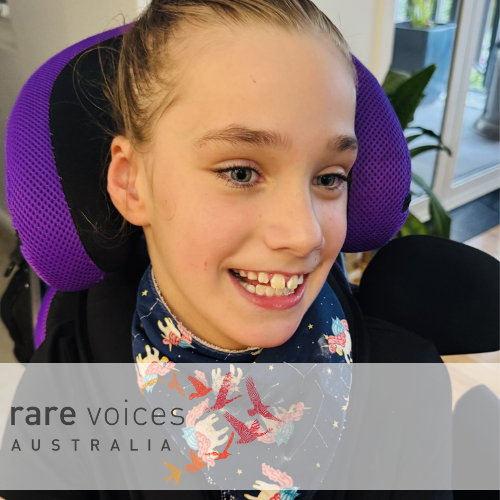
Grace was born in December 2015, our precious pink bundle of joy. We first noticed something was not quite right when Grace caught a virus at four months of age. She seemed to get progressively floppy and was failing to thrive. By six months of age, she was unable to sit up or hold her head upright. When she was eight months old, our world was turned upside down when we saw our paediatrician. He informed us that Grace had Global Developmental Delay and that he had some real concerns.
Within the week, we were sent as an urgent case to a neurologist and what followed was lots of blood tests, two Magnetic Resonance Imaging (MRI) scans of Grace’s brain and a spinal tap, which still didn’t lead us to knowing what was wrong with our daughter. For us as parents, living with such uncertainty and not knowing how to best help Grace was devastating. We felt so helpless. It was, and is still, an emotional rollercoaster for us all.
In March 2018, we were referred to a rare disease neurology team. Grace underwent genome sequencing as the doctors thought her disorder may be genetic. In June 2018, after waiting over a year, we received Grace’s diagnosis of ADCY5 Movement Disorder Syndrome. Grace was 3.5 years old at the time.
We were so relieved to finally have some answers and to find out our daughter had a normal life expectancy and intelligence levels. However, a diagnosis has not led us to a cure, and we have limited therapeutic options to help improve Grace’s quality of life.
Our amazing Grace inspires us every day as she lives with ADCY5 Movement Disorder Syndrome, a rare genetic movement disorder with a prevalence of less than one in a million. She is certainly a rare ‘gem’, and the variation of her disorder is even rarer with only one other person known to be affected in the world.
Despite her struggles with significant speech and gross motor delays, Grace always has the biggest smile on her face and loves and enjoys life. Her disorder causes her to have multiple episodes of abnormal movements throughout the day that are triggered when she gets sick, tired, anxious, stressed, or frustrated. It also causes muscle fatigue, which makes walking extremely difficult. She uses a wheelchair to enable her to get around. Grace also has low muscle tone and is unable to stand up by herself, sit unaided and the condition significantly impacts her speech.
She can experience times when her body won’t stop moving for weeks at a time. This can be life threatening as, if the movements can’t be stopped, Grace could experience respiratory failure or cardiovascular collapse. We call these times dystonic storms and they are distressing for Grace and our whole family.
Grace is an amazingly determined little girl who never gives up. Her determination and love for life are infectious and inspiring. As Grace’s family, we are passionate about raising awareness for not only our daughter, but everyone affected by rare diseases.