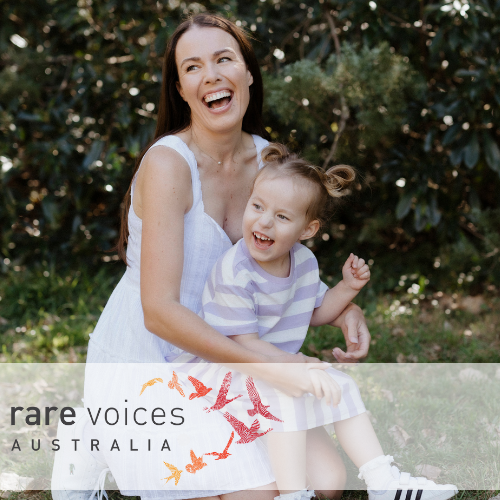
My name is Lauren. In 2021, I researched and co-authored some papers related to the rare disease workforce, therapies, and supports in Australia.
My academic background is in social research, and after nearly a decade working in federal health policy, my passion for achieving equity of access for underrepresented groups made niching into rare disease projects feel both ‘meant to be’ and like a natural fit.
What I didn’t realise at the time was that this ‘meant to be’ feeling would take on deeper meaning in ways I couldn’t yet understand. While conducting research in the rare disease space, I happened to be pregnant with what was my second ‘textbook’ pregnancy, already raising an energetic, healthy, typically developing toddler at home.
Our daughter, Sage, was just 10 days old when I woke my husband in the middle of the night and told him, wide-eyed, that I suspected she had a rare syndrome. We’d had no flags raised – her birth was uneventful, her APGAR scores (a test used to assess a newborn’s overall health and well-being immediately after birth) were good, and we were discharged just 14 hours later.
However, I recognised some of the syndromic markers I had learned about during my rare disease research and focus groups, and some of those markers were present in Sage. Mild and easily overlooked physical traits (known as ‘dysmorphic’ features) and developmental delays became visible during her first year of life. As each new trait surfaced, I documented everything, conducted my own research, and advocated fiercely to access early intervention supports and, critically, to secure a referral to a geneticist for testing.
Sage and I dove headfirst into a packed schedule of six therapies, and I was fortunate to delay returning to work. She became a National Disability Insurance Scheme (NDIS) participant just after turning one, classified under the ‘Global Developmental Delay’ umbrella. By the time Sage was 18 months old, we first met with our geneticist – opting to go privately and drive from Canberra to Sydney for appointments in order to be seen quicker.
In February 2025, at three years and three months old, Sage was diagnosed with NEDDFL Syndrome (an acronym for the lengthy title: ‘Neurodevelopmental Disorder with Dysmorphic Facies and Distal Limb Anomalies’). This condition is caused by a mutation in the BPTF (Bromodomain PHD Finger Transcription Factor) gene on her 17th chromosome, identified through trio whole exome sequencing of Sage, my husband, and me.
The mutation is ‘de novo’, meaning it wasn’t inherited from either parent and doesn’t affect her soon-to-be six-year-old brother. As far as we can find, Sage is the only person in Australia with this diagnosis so far, and globally, there is estimated to be around 40 cases.
NEDDFL Syndrome is classified as a neurodevelopmental disorder because the BPTF gene plays a critical role in brain processes essential for development. For individuals with the mutation, impacts are significant, spanning multiple domains of function, and are lifelong. The available literature is very limited, but we are in touch with geneticists at Baylor College of Medicine in Texas, in the United States, who are leading research in this area. Thanks to the internet and social media, we also stay connected with other families around the world through a WhatsApp group.
Sage is, simply, Sage. While NEDDFL Syndrome is a defining feature of her life, it doesn’t define who she is. We call Sage the sunshine in our days – she is the most loving, warm, resilient, and determined person we’ve ever met. She gives her all to therapy sessions, always smiling brightly. Her greatest loves in life—aside from her family and friends—are chocolate and dogs.
As for Sage’s future, her current outcomes and trajectory look very positive. We believe that the intensive early intervention she received, paired with her relatively early diagnosis, has already shaped—and will continue to shape—her quality of life.
Whether Sage was ‘meant’ to be my daughter, or I was ‘meant’ to be her mum, she is our greatest gift (alongside her remarkable big brother). While there have been challenges and sacrifices, this journey has brought incredible silver linings. Our family has learned to slow down, celebrate even the smallest wins, champion one another, and embrace inclusivity, accessibility, and diversity. We’ve crossed paths with so many inspiring individuals driven to create meaningful change.
It’s undeniable that the work I did in rare disease while pregnant with Sage directly enabled her early therapeutic intervention and diagnosis. Every single person involved in her care and diagnosis has agreed on this point.
We hope to use Sage’s story to highlight the urgent need for greater focus on early diagnosis and intervention pathways for all rare diseases. While not all rare diseases are syndromes, for those that are, recognising the ‘constellation’ of syndromic markers is critical to avoiding underdiagnosis or delayed diagnosis.
As for me? I am now even more deeply committed to contributing to the rare disease community, joining the groundswell of passionate individuals dedicated to improving the systems where we live, learn, work, and receive care. Drawing on my professional expertise and my lived experience as Sage’s mum and caregiver, I hope to play a meaningful part in advancing our collective mission.
Note: Lauren researched and co-authored RVA’s Rare Metabolic Disease Workforce White Paper: Towards a Strengthened Rare Disease Workforce for Australia in 2021.
Lauren is one of our 2025-27 RVA Ambassadors.