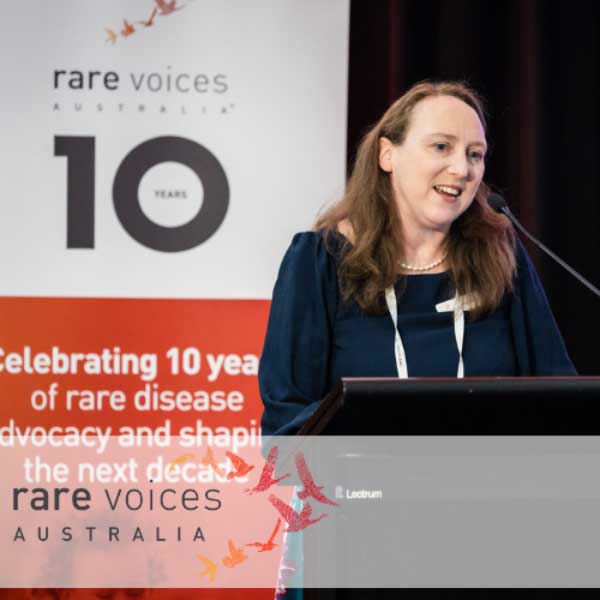
I’ve been the Chief Executive Officer (CEO) of Rare Voices Australia (RVA) since June 2016. RVA’s focus is systemic advocacy—we focus on rare disease policy, processes and systems. However, my ‘systemic advocacy’ first began as a rare disease mum back in 2008 with my then seven-year-old son who lives with a rare disease when I started noticing more signs of deterioration in terms of his condition.
At the time, one of my coping strategies—to make things ‘ok’—was to make sure we went to every possible appointment, saw every specialist and embraced every suggestion to respond to the symptoms. This involved physiotherapy, occupational therapy, monitoring tests, trying various appliances and proceeding with multiple procedures and surgeries.
Eventually, we reached a point when my son needed surgery to ‘fix’ and address several issues. However, the anaesthetist said no as my son was deemed too high risk in terms of being anaesthetised. The anaesthetist wrote an assessment letter with the words, “Risk of death is too high for general anaesthetic.” Something clicked in me. I could no longer make things ‘ok’.
I became aware that there was an approved treatment for the condition my son lives with. The treatment was available overseas but not in Australia. I had no idea why that would be.
Naively, I rang the pharmaceutical company that developed the treatment to ask when it would be available in Australia. The person I spoke with said a string of words that included a whole lot of letters I did not understand: “Lots of hurdles. TGA, PBAC, LSDP.” Although confused, I remember asking again, “But how long?” I still recall hearing the reply like it was yesterday. “Lots of hurdles. There are likely to be delays, but if it all goes well, at least 18 months.”
I was so naïve that I thought 18 months sounded like such a long time. I asked, “What can I do to make the process quicker?” I will never forget the response. “Lobby Government.”
I took the words literally. It was only years later after reflecting on the whole experience that it finally dawned on me: The person was being sarcastic!
I had no idea how to ‘lobby Government’, but I was pretty good at figuring things out and learning on the go. I think my extended family thought this would be a passing phase, another one of my coping strategies, and some of them urged me not to go overboard. I was working as a very part-time social worker and reassured those around me that I would keep it all very contained. I then quit my job and decided to treat this as my little job instead, so that what I was doing wouldn’t be too overwhelming. (See how naïve I was?) To be honest, I think my family reluctantly indulged me.
I learned political advocacy on the go as I went along. There was a lot of trial and error, and I asked a lot of people a lot of questions. I engaged with both sides of government and developed a strong relationship with my local Member of Parliament who ended up championing the issue directly with the Federal Health Minister at the time. I continued communicating regularly with the pharmaceutical company that marketed the treatment, while navigating the reality that they often could only provide information to my GP and not me! I kept other families updated and they often helped with letter writing and media.
My mother-in-law often used to say, “You catch more flies with honey than vinegar.” I continually channelled this approach with every meeting and engagement. I always thanked people for being so generous with their time. Often, the people I spoke with didn’t have the answers I needed. Over time, I learned not to directly ask people to help me but to instead say, “Do you have any suggestions as to what I can do next?” This worked much better. If more than one person made the same suggestion, I gave it a go.
There were many challenges along the way. It wasn’t all rosy. Sometimes, it was incredibly frustrating. I felt a range of emotions like helplessness, anger and at times, there were tears.
The Outcome
To cut a long story short, the approach worked. My son gained access to the treatment nine months after that first call to the pharmaceutical company. The treatment was then made available to others with the same condition a month or so later. That meant the treatment was available in Australia in nine rather than 18 months. Effective systemic advocacy had halved the access to treatment time.
Key Learnings
My main learning from this experience is that understanding systems, policy, processes and health technology assessment (HTA) is critical to systemic advocacy that’s effective. Key factors include:
- What is being assessed.
- The role and function of each part of the process.
- The questions being asked and at what time and stage of the process.
- Who the decision-makers are.
- How to best engage and influence the decision-makers.
Health Technology Assessment (HTA)
This experience was the start of my strong interest in HTA advocacy—first in my role as a patient support group leader and then as CEO at RVA. I’ve since been involved in developing a range of submissions and various advocacy regarding things such as the Life Saving Drugs Program (LSDP) Review, the Parliamentary Inquiry into approval processes for new drugs and novel medical technologies in Australia, the National Medicines Policy Review and the HTA Policy and Methods Review. I’ve also been privileged to be appointed to formal HTA roles as a consumer nominee for the LSDP Expert Panel, the HTA Review Implementation Advisory Group (IAG) and the Co-design Working Group for the HTA Enhanced Consumer Engagement Process.
The rare disease sector continues to be such a key player in HTA reform as the sector’s expertise, knowledge and sophistication continues to grow and evolve. It’s amazing to see RVA Partner group/organisation leaders so engaged in HTA policy reform.
RVA advocated strongly for rare disease expertise to be included in the HTA Review IAG, and as a result, a rare disease consumer representative position was designated in the group’s membership structure. I was honoured to be subsequently appointed to that role on the HTA Review IAG.
The HTA Review IAG undertook a lot of work in 2025. At the time of writing (January 2026), the HTA Review IAG’s final report and roadmap is now with the Hon Mark Butler MP, the Minister for Health and Ageing and the Minister for Disability and the National Disability Insurance Scheme. With my formal role on the HTA Review IAG now complete, I am as impatient as everyone else for the implementation advice to be acted upon to progress tangible HTA reform that benefits Australians living with a rare disease.